
Gray AND bright: 5 Steps to unlocking joy when things feel heavy
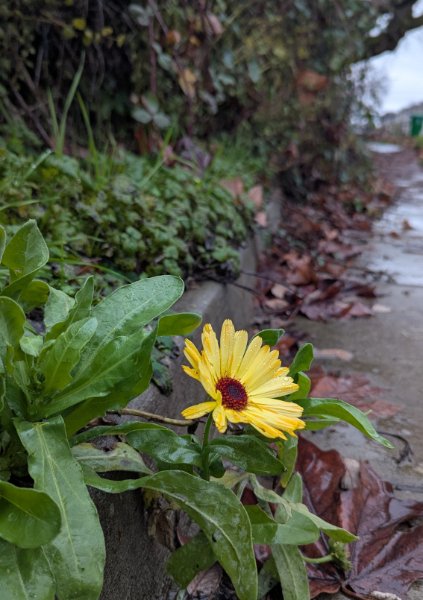
The bright Gerbera daisy, flourishing under gray skies
This morning I went for a run in the cold Portland rain. Gray skies, wet pavement, that penetrating Pacific Northwest drizzle that makes you question why you left the house. And then, there it was. A single bright yellow flower, vibrant and impossible to ignore, blooming right there in the middle of all that gray.
Not gray OR bright. Gray AND bright. Both at once.
This is the heart of the work I do with climate advocates, sustainability leaders, and anyone carrying the weight of our changing world. We've been taught to choose: either face the crisis with full gravity, or step away to find joy. Either stay serious and effective, or be light and frivolous.
But what if that’s a false choice?
Last week, I ran a workshop called "Unlocking Joy in Our Changing Climate." What we explored together is that you can't force joy any more than you can force that yellow flower to bloom. But you can create the conditions where joy becomes possible, even in the rain. Especially in the rain.
Here are the five steps we explored:
Step 1: Noticing & Naming
We started with Sensing Opposites - a practice I first learned from the Inner Development Goals Summit - of noticing two different sensations in your body at the same time. Your shoulders might feel tense while your knees feel relaxed. You might notice sadness in your chest and hope in your cheeks.
When we learn to notice and name what's actually happening - what Dr. Dan Siegel calls "name it to tame it" - we discover something powerful: opposites can be true at once. You can feel both overwhelmed by climate news AND curious about solutions. Grief for what we're losing AND hope for what we might create.
When we named what we were noticing, something shifted in the room. People could feel into the wisdom of their bodies, recognizing both the differences and the similarities of sensation.
Step 2: Accepting & Allowing
This is often the hardest step, and one I wish we'd had more time to explore fully.
We all have different parts of ourselves: the thought that says "I'm not doing enough," the part that wants to give up, the resentment about why we’re even having to face these problems. Internal Family Systems calls these "parts" - neural networks shaped by our experiences, and posits that there are no bad parts.
Here's what I've learned from years of coaching and doing my own inner work: when we resist these parts, they get louder. When we make room for them, we actually rewire our brain and something shifts in our nervous system. We can hold the part that's struggling AND the part that's resilient. We can make room for despair and determination.
The goal isn't to get rid of the hard parts. The goal is to stop being at war with ourselves so we have more energy for the actual work.
Step 3: Seeking Help & Building Community
We did a simple activity: everyone lined up based on how easy or hard it is to ask for help.
Most people stood toward the "very hard" end.
It shouldn’t surprise me that it’s like this, but it’s ironic that the people most committed to helping the world often struggle most with asking for help themselves. Many of us have internalized this idea that if we're really capable, we should be able to handle it alone.
But asking for help is a both/and practice. You can be competent AND need support. Strong AND struggling. Clear on your purpose AND unclear on next steps.
Step 4: Practice
This step is full of possibilities, and can be hard to choose where to focus.
In this workshop, we explored play, body, and nature - not as bonus self-care, but as essential practices for accessing the curiosity, creativity, and calm we need to be effective. We played a game (one of my favorites!), and connected the neuroscience of movement to being in our bodies.
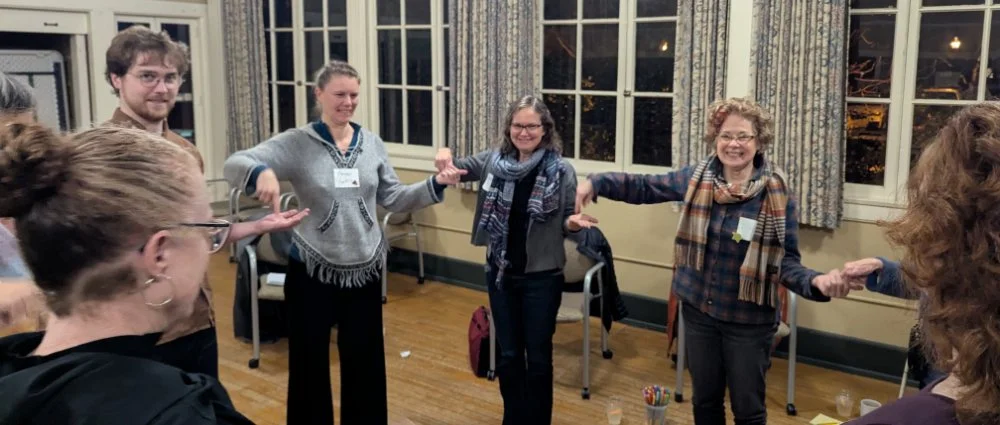
Playing one of my favorite group games: Get the Point
We discussed how brief moments outside, as well as bringing nature indoors, can help us toggle between the stress of overwhelming realities and the groundedness we need to keep showing up.
The point isn't to escape the work but to build the capacity to stay in it.
Step 5: Rest & Repeat
We closed with a breath practice. Not because breathing fixes climate change, but because rest is where integration happens.
This step is both the ending and the beginning. You have to keep creating the conditions. Keep noticing. Keep making room. Keep asking for help. Keep practicing. Keep resting.
We're learning to move more fluidly between gravity and lightness, between action and restoration, between the work and the wonder.
Both/And
That yellow flower is still out there in the rain. It hasn't decided to be bright OR survive the gray. It's doing both.
So can we.
The climate crisis is real and urgent. AND we need joy to sustain our work.
The situation is dire. AND there's still so much worth working towards.
We're exhausted. AND we're not giving up.
These five steps aren't about forcing feelings or performing optimism. They're about creating space for our whole selves to show up - the parts that are grieving and the parts that are alive with possibility.
Because the lighter side of ourselves isn't separate from the serious work. It's what makes the serious work sustainable.
